Description
This workshop is specifically for Old school Potters. Not sure if you are an Old School potter? Old School Potters are those foks who regularly attend open studio.
It is a 3 day workshop. The first day you make the pot. The second day, April 10, you trim it. At that time you will be given a jar of terra sigliatta. Once your pot is bone dry, you will apply the terra sigliatta and burnish it. You will need to bring the pot back by Wednesday the 15th so that it can be bisqued. The first 2 days will be April 3 and April 10 from 3 – 5 pm. If you can not make these dates, you can not do this workshop. When we get together, we can look at the weather forecast to figure out the potential day for firing. ideally, I would like to do the firing April 18 or 25 from 4 – 6 pm.
This is an experimental workshop to test the process for naked raku. This vdeo explains naked raku. Sorry to disappoint you, but it is a process where one is fully clothed.
You will be given 1.5 pounds to make your creation. Because raku clay is low fire, we need to keep it separate from the rest of the clay of the studio. If it were to get mixed up with our regular clay, it could lead to chunks of pots melting out in the glaze firing, leaving big gaping holes, and a mess in the kiln.
There are two types of naked raku firing. One method involves putting horse hair and downy feathers on the pot once it is pulled from the raku kiln. Those things then carbonize on the pot leaving a cool carbon imprint on the white clay. Vincent Garcia is a Connecticut artist who uses feathers and his own hair (I think) is his naked raku process. In the other process, another layer of slip is added to the pot, and that goes into the raku kiln. The pot is pulled from the kiln and reduced in newspaper. The extra layer of slip cracks on the pot, and the carbon from the newspaper penetrates the cracks and leaves a cool carbon pattern.
The biggest unknown in this process is the terra sigiliatta. I have never made it before, and while I have watched countless videos, it is a new thing for me. The other unknown is the slip that is appied for the raku firng. It has to stick on the pot long enough that it doesn’t all fall off in the raku firing and when pulled from the kiln, you are left with a bare pot. Lastly, if using feathers, some feathers work better than others. it needs a downy feather to make a nice imprint. Old feathers do not burn fast enough and will just make a mess.
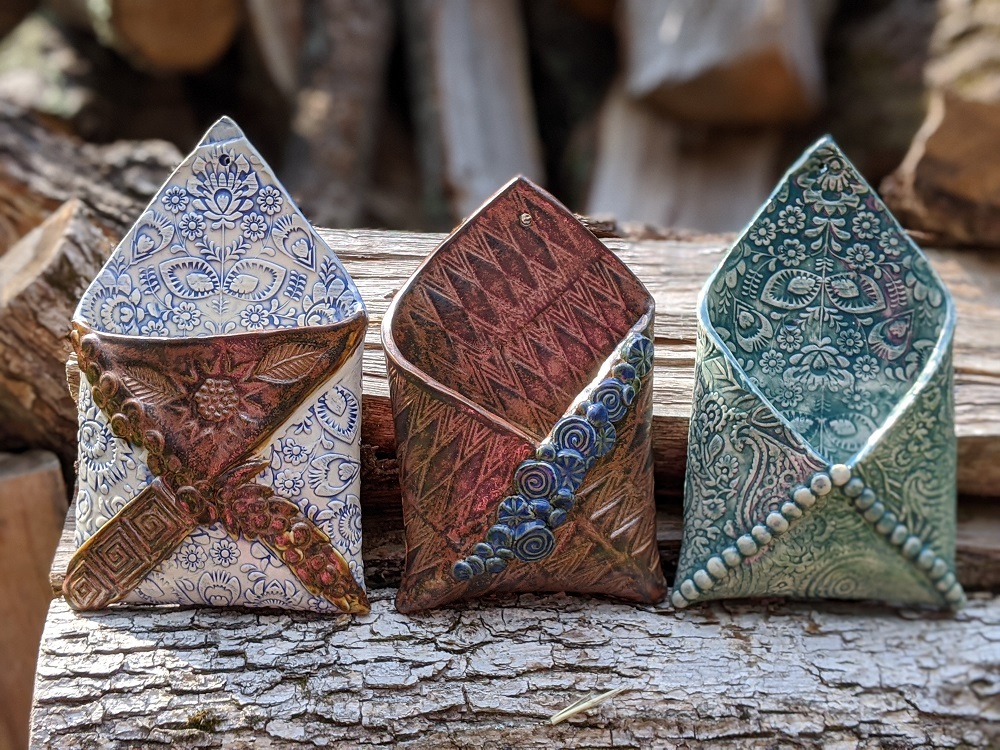
These artists have some gorgeous examples of naked raku: https://www.kildoagpottery.com/naked-raku/
Lastly, this is an experiment. As an experiment, in order to help all the potters of Old School Clay, you wil be required to document your process so that we can all learn how to do it better. If many folks ask to sign up for this workshop, priority will be given to folks who have a history of documenting their results (or at least can recall what they did).
I am hoping I can get 8 of you to learn best methods to do this process. We can do this in colder weather than regular raku becuase it is ok if pots cool fairly quickly. If more testing is needed – which is likely – I will open it up to another group of folks.
This workshop is free. I appreciate your help. Typical of raku, these pots are decorative.